
Critical Made in Italy Part 5: Environment and Nutrition (Panel Discussion – Sept. 26, 2019)
Posted in: Inserra Chair Events, Italian News and Events, World Languages and Cultures

From the left: Dr. Jorge Lorenzo Trueba, Prof. Teresa Fiore, Prof. Maurizio Cellura, Wayne DeFeo听
The food sector is one of the most energy intensive in the modern economy, and thus a significant contributor to global warming. What kind of practices are already activated in this sector that help fight climate change?听 (University of Palermo, Italy) and (DeFeo Associates Environmental Consulting, NJ) addressed the topic at the fifth part of the titled听on Thur Sept. 26. They explored the case of farms, companies, and towns in Sicily and New Jersey whose sustainable approach to food production, distribution and consumption provides interesting stories about environmental protection.
 听听
听听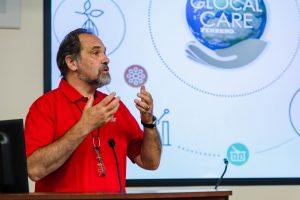 听听
听听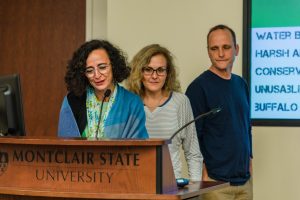 听
听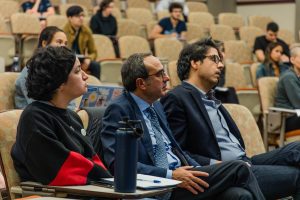
From the left: 1. Prof. Cellura, 2. Wayne DeFeo, 3. Courtney and Brian Foley behind Prof. Fiore, 4. Prof. Cellura with his colleague Dr. Guarino and, to his left, student Valery Villalobos, activist for a fully sustainable food offer on campus
The program was enriched by听two local cheese producers, Courtney and Brian Foley, founders and owners of . They make water buffalo Mozzarella in Warren County New Jersey: inspired by the buffalo farms in Italy, they have decided to produce buffalo mozzarella in the US to also reduce the carbon foot imprint of the imported product. Their enterprise is a model of sustainability also because their buffalos are animals of low level impact on the environment. Their story reflects the growing NJ scene of small farmers emphasizing the importance of going back to the land. Yet this choice come with a price, as staying competitive in the market is not easy, and ironically some of the inter-state regulations impose the use of plastic containers thus challenging the principles of their sustainable vision.
During the Q&A, organizer and moderator听 (Inserra Chair) was interested in understanding how much Italy can be a leader in this sector. Jorge Lorenzo Trueba (Earth and Environmental Studies) explained that new techniques to re-direct the flows of plastic accumulation in the ocean towards the shore so that they can be properly recyled are already in place.
“As a molecular biology major, the panel interested me very much. There are holistic measures society must undertake, such as revamping economical systems by decarbonizing industries and expanding renewable energy. However, citizens should also be responsible for making small changes in their day-to-day lives,” Kevin Saez remarked. “I found this event to be really eye opening: it really made me want to make a change on our campus and our society in general. This event expressed the severity of the state of our planet and how we need to make a change now before it is too late,” student Rachel听Giannakopoulos wrote in a post-event activity. “I love gardening: I walked away from the event wanting to do more, wanting to talk to others about these problems and solutions,” Ally De Marco added. “The night鈥檚 conversations were extremely thought-provoking, and although initially grim, concluded with the note that the worst is not here yet; humanity has time to change its actions, but they must do so as soon as possible!” concluded Gaby Davila. “I am an English Major, and Environmental issues interest me profoundly. Just as much as I believe that positive change starts within the family structure, I believe that environmental studies should be taught to all,” Mariadelmar Valencia specified, echoing a comment coming from high school teacher Patti Grunther who proposed the inclusion of these subjects in the K-12 curriculum.

This event was organized and sponsored by the at 精品成人福利在线 University, in collaboration with the Italian Program (Department of Modern Languages and Literatures), the Department of Earth and Environmental Studies, and the Department of Nutrition and Food Studies at 精品成人福利在线 University. Refreshments were kindly offered by听.
The 精品成人福利在线 U newspaper听The Montclarion covered the event听in the article by听Lauren Lamantia (Oct. 1, 2019).
For more information about the event, see webpage.